STEMI can be Type 1 or Type 2 MI?
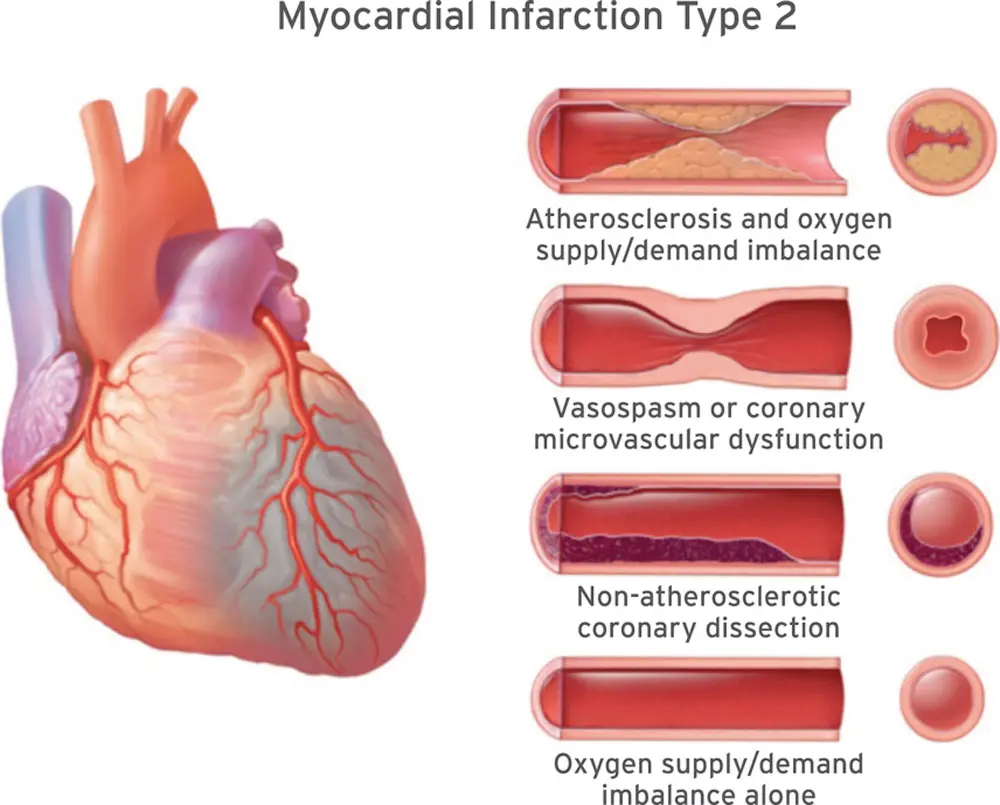
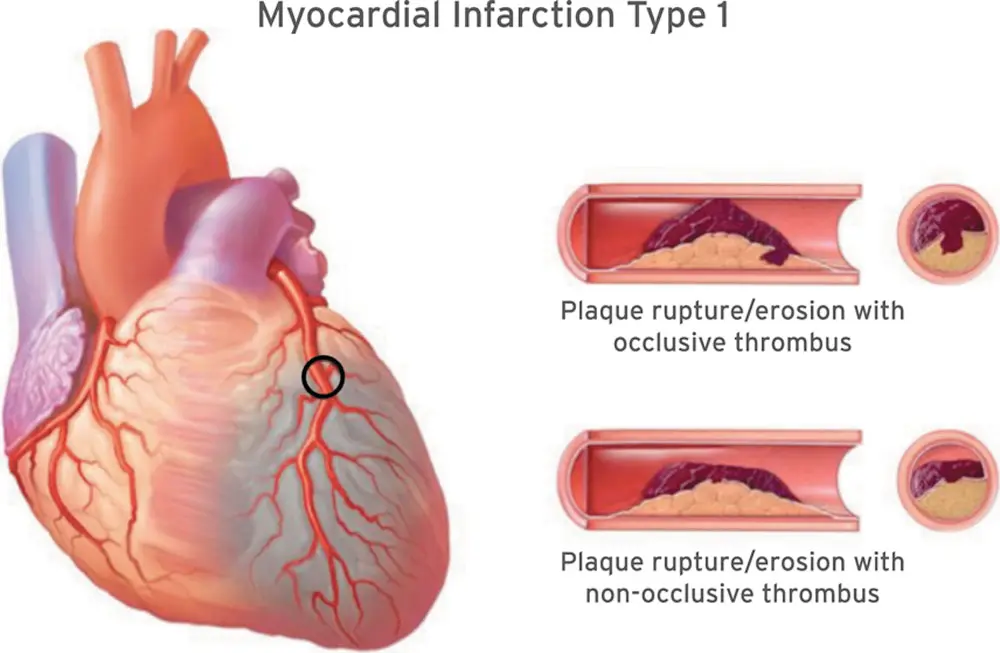
It is possible for a STEMI (or NSTEMI) to be either a Type 1 or Type 2 MI. While a STEMI most commonly is due to atherothrombotic occlusion (Type 1 MI), it can also occur in patients without this, e.g. coronary vasospasm or SCAD, and would be classified as Type 2 in such circumstances.
Types of Acute MI (Universal Definition of MI)
4th Universal Definition 1
- Type 1: Caused by acute coronary atherothrombosis, usually precipitated by atherosclerotic plaque disruption (rupture or erosion) and often associated with partial or complete vessel thrombosis.
- Type 2: Caused by an imbalance between myocardial oxygen supply and demand unrelated to acute coronary atherothrombosis.
- may be secondary to another clinical illness or process
- Examples
- decreased myocardial perfusion due to fixed coronary atherosclerosis without plaque rupture
- Coronary Artery Spasm
- CMD
- Coronary embolism
- SCAD
- Decreased O2 supply, e.g. severe bradycardia, hypoxic/hypoxemic respiratory failure, severe anemia, and hypotension/shock
- Increased myocardial O2 demand due to sustained tachyarrhythmias or severe hypertension.
- Type 3: Cardiac death, with symptoms of myocardial ischemia and presumed ischemic electrocardiographic changes or ventricular arrhythmia, before blood samples for cardiac biomarkers can be obtained or increases in cardiac biomarkers can be identified and/or in whom MI is identified by autopsy.
- Type 4
- 4a: Peri-PCI MI caused by a procedural complication and detected ≤48 h after PCI.
- 4b: Post-PCI MI caused by coronary stent or stent scaffold thrombosis.
- 4c: Post-PCI MI caused by coronary stent restenosis.
- Type 5: Peri-CABG MI caused by a procedural complication detected ≤48 h after CABG surgery.
Type 2 MI
- 2 took 100 patients with Type 2 MI and got coronary and cardiac imaging
- “median cardiac troponin I concentrations were 195 ng/L (interquartile range, 62–760 ng/L) at presentation and 1165 ng/L (interquartile range, 277–3782 ng/L) on repeat testing.”
- “The prevalence of CAD was 68% (63 of 93), which was obstructive in 30% (28 of 93). Infarct-pattern LGE or regional wall motion abnormalities were observed in 42% (39 of 93), and LV systolic dysfunction was seen in 34% (32 of 93).”
- Only 10 patients, i.e. 10%, had both normal coronary and normal cardiac imaging 😱
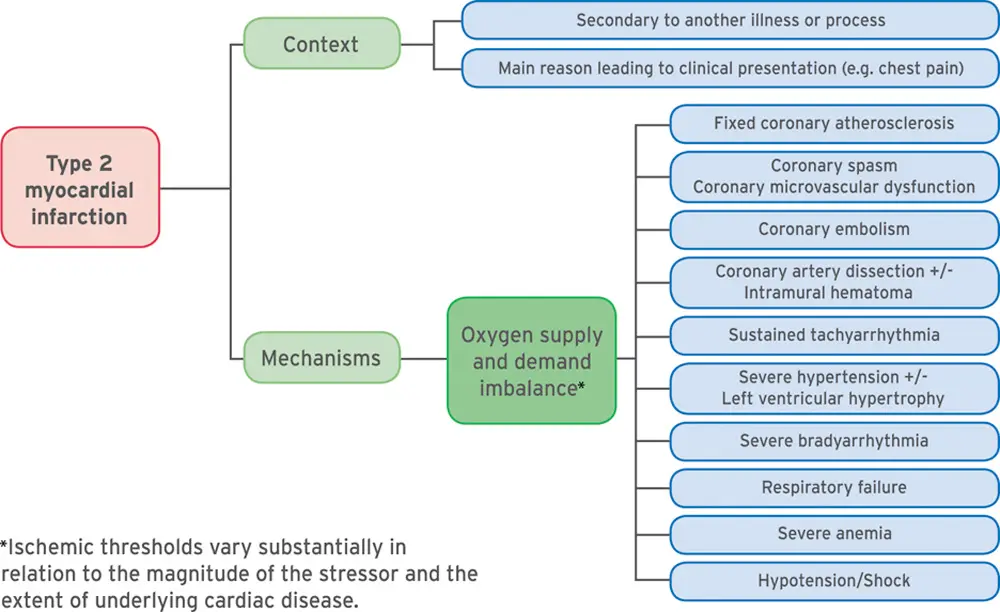 Figure source: 1
Footnotes
-
Thygesen K, Alpert JS, Jaffe AS, Chaitman BR, Bax JJ, Morrow DA, White HD; Executive Group on behalf of the Joint European Society of Cardiology (ESC)/American College of Cardiology (ACC)/American Heart Association (AHA)/World Heart Federation (WHF) Task Force for the Universal Definition of Myocardial Infarction. Fourth Universal Definition of Myocardial Infarction (2018). Circulation. 2018 Nov 13;138(20):e618-e651. doi: 10.1161/CIR.0000000000000617. Erratum in: Circulation. 2018 Nov 13;138(20):e652. doi: 10.1161/CIR.0000000000000632. PMID: 30571511. ↩ ↩2
-
Bularga A, Hung J, Daghem M, Stewart S, Taggart C, Wereski R, Singh T, Meah MN, Fujisawa T, Ferry AV, Chiong J, Jenkins WS, Strachan FE, Semple S, van Beek EJR, Williams M, Dey D, Tuck C, Baker AH, Newby DE, Dweck MR, Mills NL, Chapman AR. Coronary Artery and Cardiac Disease in Patients With Type 2 Myocardial Infarction: A Prospective Cohort Study. Circulation. 2022 Apr 19;145(16):1188-1200. doi: 10.1161/CIRCULATIONAHA.121.058542. Epub 2022 Mar 28. Erratum in: Circulation. 2022 Apr 19;145(16):e841. doi: 10.1161/CIR.0000000000001070. PMID: 35341327; PMCID: PMC9010024. ↩